



Construction projects, underground assets, and above-ground assets — one platform, start to finish.
October is a busy month for our team. We’ll be in San Antonio for SAP for Utilities, Presented by ASUG, October 7–9, and three weeks later in Palm Springs for Esri IMGIS 2026 on October 27–29. Two conferences, two of the most important technology ecosystems in our industry, and one question I expect to hear at both booths: we’ve already invested in these systems, so why does the work in the field still feel disconnected from them?
It’s a fair question. The systems of record were never the problem; SAP runs the back office and financial backbone, Esri ArcGIS holds the network. Both are excellent at what they were built to do, and no utility should have to walk away from them. We don’t ask you to abandon investments that work; we amplify their value.
The problem lives in the space between those systems and the crew in the truck. A work order is created in one place, the asset lives in another, the map is a printout or a separate app, and what actually happened in the field waits days or weeks to make it back into the record. Every one of those handoffs is a place where a record falls behind, a job gets re-keyed, or a crew loses part of a morning to a screen that was never designed for them. Industry estimates put the productivity lost to disconnected systems at 20–30% of a workforce’s time. Executives feel it as a rising cost per job. Crews feel it as eight applications on a ruggedized laptop.
SAP for Utilities: SAP as the Foundation, KloudGin in the Field
 For an SAP-running utility, SAP provides the back office foundation. What KloudGin brings is the operational layer on top of it: planning projects, managing assets both above and below ground, coordinating crews, and executing field work, with progress and actuals connected back to SAP. Asset, construction, and field service management on one platform, running alongside SAP rather than inside it.
That’s what “better together” means in practice, and it’s how SnoPUD, Sacramento Municipal Utility District (SMUD), National Fuel Gas (NFG), and DC Water all run KloudGin today, each in a different SAP environment. Our SAP-certified integration adapter, available on the SAP® Store, was co-developed with SnoPUD. Because KloudGin is multi-tenant, every SAP customer in our network received it. It turns the 6–12 months a custom integration usually takes into weeks, and it carries no customizations, so it holds through every SAP upgrade. That isn’t only our view: IDC recently named KloudGin the only vendor recognized as a Leader in both AI-Enabled Enterprise Asset Management and Field Service Management for utilities — validation, from outside our own walls, of what “better together” actually delivers.
At Booth 422 we’ll be running the full platform live, from construction through field operations. Come see what a work order from SAP, an asset from the GIS, and one screen for the crew actually looks like.
The Third Partner in That Story
The same crew that needs the SAP work order needs the map, the network trace, the asset’s condition and history, and driving directions to get there, and they need all of it on one screen, in one app. That’s why the SAP story and the Esri story are the same story for us. KloudGin is an Esri Gold Partner, and Esri GIS is embedded in every work order on the platform: crews open work on the live map, run a network trace, see the asset’s condition and history, and capture as-builts and redlines in the field, all on one screen, with progress and actuals connected back to SAP.
Which is why, three weeks after SAP for Utilities, we’ll be at Esri IMGIS, and why two of our customers will be on the agenda there telling that story themselves.
Esri IMGIS: Pasadena and El Paso Electric Tell It Themselves
Two of our customers were selected to present at Esri IMGIS this year, and I’d encourage anyone attending to put both sessions on their calendar.
On Wednesday, October 28, Jeremy Marquette and Thais Gomes of the City of Pasadena will share how Pasadena Water and Power is replacing 38 different systems — software, spreadsheets, and paper — with a single platform for asset and work management across water and electric operations, with Esri GIS as the spatial foundation. Thirty-eight. I’ve shared that number with a lot of people this year, and it still stops the conversation. What I find most valuable about Pasadena’s story isn’t the consolidation itself; it’s what the team will share about getting there — fragmented operations, a retiring workforce, and the practical work of breaking down silos between departments that had each built their own way of working.
On Thursday, October 29, Lizeth Navia-Schmenk and Mario Hernandez of El Paso Electric will walk through how EPE replaced its legacy field service system and middleware with one platform connected directly to Esri ArcGIS Utility Network and Oracle Customer Care and Billing. Eleven departments that ran on disconnected systems now run on one, and a manual 5 AM dispatch process gave way to Dispatch Center 3.0 and AI Assisted Scheduling. They’ll cover the time and cost outcomes, the workforce changes that followed, and what it took to tune automated dispatch for a large, geographically distributed field workforce.
A municipal water and electric provider and an investor-owned electric utility, arriving at the same idea: keep the systems of record where they belong, and give the field one system that works from all of them. That’s the whole thesis, told by the people who lived it.
The Decision Has Moved to the Field
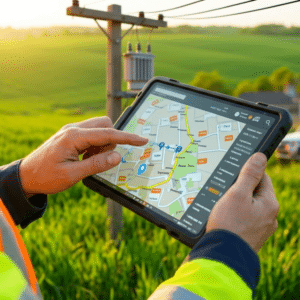 For most of my career, the big technology decisions in a utility were made in the office: which ERP, which GIS system. Those decisions are largely made. The systems are in, and they’re good. The decision that matters now is what the crew works from at 6 AM, and whether what they do out there makes it back into those systems the same day or the same quarter.
That’s where the next few years get decided. The workforce that carries the institutional knowledge is retiring. The grid is taking on more assets, more distributed resources, and more severe weather than it was built for. None of that gets solved by another system in the office. It gets solved by giving the people in the field one screen that draws on everything the office already knows.
Together, KloudGin’s customers serve more than 35 million people across the US, one in every ten Americans, and Pasadena, El Paso Electric, SnoPUD, SMUD, and every other utility in that number didn’t get there by adding another system to the office. They got there by deciding the systems they already had should finally work together in the truck.
I believe that’s where our industry is headed, and October is a good month to see it up close. Meet our team at SAP for Utilities, Booth 422, October 7–9 in San Antonio, and at Esri IMGIS 2026, Booth 116, October 27–29 in Palm Springs. I look forward to seeing you there.