



Nearly one-third of the utility workforce reaches retirement eligibility this year. Over the next five years, that number will climb to 40%. Behind those percentages is something harder to count: decades of institutional knowledge that lives in people’s heads. The technician who knows which valve sticks in cold weather. The dispatcher who knows which contractor shows up. The engineer who remembers why that substation was configured the way it was, because they were there when it happened.
When those people retire, that knowledge goes with them — unless it has been captured somewhere a newer workforce can find it.
Meanwhile, the data that could hold that knowledge is everywhere and nowhere. It sits distributed across structured systems and unstructured sources — work orders, asset histories, inspection reports, field notes, photos, spreadsheets, email threads. And the volume is only growing, because more assets come online every year: customer-owned solar, batteries, EV chargers, sensors across the network. The industry is gaining data exactly as it loses the people who know what the data means.
This is the real context for the AI conversation in utilities: a workforce transition colliding with a data explosion, and the question of whether the next generation of workers will inherit their predecessors’ knowledge or have to relearn it the hard way.
Where operational AI differs from the rest
Most enterprise AI sits apart from the work. It summarizes documents, drafts emails, answers questions about policy manuals. Useful, but it doesn’t know what’s happening in the field right now, and it can’t act on it.
An operational AI system is different in kind, not degree. It has to be grounded in real-time operational reality — what’s planned, what’s in progress, what just changed, which crew is where, what the asset’s history says. That grounding is only possible when construction, asset, and field service run as one connected operation rather than scattered across systems that reconcile overnight, if at all.
That’s why KloudGin built the AssetIQ family of agents natively into the Single Face of Work® platform rather than bolting AI onto the outside. AIQ Atlas works as a field copilot: a technician can create and complete work orders by voice, document a job hands-free through R3, and identify an unfamiliar asset visually with LENS. Every interaction captures knowledge that once left with the shift — and puts the platform’s full asset history in the hands of a technician who wasn’t there for the last 30 years of it. AIQ Apollo does the equivalent for administrators and power users, turning plain-language prompts into configurations and workflows that once required specialists.
The pattern matters more than the features. AI amplifies whatever foundation it stands on. Stand it on fragmented systems and it automates confusion faster. Stand it on a unified, current record of work and assets, and it becomes the bridge between a retiring workforce and the one replacing it.
The newer workforce is a design requirement
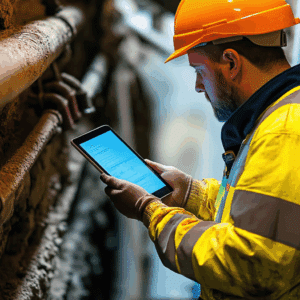 The workers entering utility field operations grew up with technology that works the way consumer technology works — immediate, intuitive, mobile. Hand them eight applications on a ruggedized laptop and a binder of tribal knowledge, and they won’t stay. The utilities winning the talent competition are the ones whose tools feel like an advantage, not an initiation ritual.
The economics land in the same place. When AI-native tools and unified data recapture an average of 30 minutes per worker per day, that time multiplies across thousands of workers into millions in annual value. At KloudGin, we call it Return on Employee, because the constraint on the industry’s next decade is people — how much of their day goes to the work itself rather than to fighting the systems around it.
Set the foundation before the wave
Every utility will adopt operational AI eventually; the pressures guarantee it. The choice available today is whether to set the foundation deliberately — unify the record of work, capture knowledge as a byproduct of doing the job, give the incoming workforce tools they’d choose — or to bolt AI onto fragmentation and hope.
The workforce transition won’t wait for the technology roadmap. The people who know how the system really works are retiring on their schedule, not the utility’s. The time to start capturing what they know is while they’re still here to teach it.