


In recent months, I’ve written about the fragmentation challenge facing utilities and why we built KloudGin around a Single Face of Work®. The response from utility and municipal leaders has been overwhelming—but in deeper follow-up conversations, one critical theme kept emerging: the challenge isn’t just about too many systems. It’s about the fundamental operational realities that most legacy platforms were never built to handle.
Utilities and public-sector organizations face unique operational complexities. You manage thousands of distributed assets across vast territories, while field crews work across multiple jurisdictions, asset types, and work categories daily. A water technician may repair a main break in the morning, conduct hydrant inspections at midday, and address a customer’s high bill complaint in the afternoon—all distinct workflows that each traditionally require different systems.
The question isn’t whether this complexity exists. It’s whether your technology can support it without forcing artificial operational silos.
The Three-Dimensional Challenge
Most software vendors talk about unification, but few deliver it. They may optimize for only one or two dimensions—asset management or field service; linear assets or vertical assets; utility-owned assets or customer-owned assets; planned work or emergency response; internal crews or contractors. This forces impossible choices that don’t reflect how utilities actually operate.
Operational excellence today requires simultaneous unification across three critical dimensions: all work types, all asset classes, and all work groups.
All Work Types: From Minutes to Years
 Utility operations span enormous temporal ranges. Emergency response requires dispatch in minutes, while routine maintenance operates on daily or weekly cycles. Capital projects unfold over months and years. Most platforms force a trade-off, making you choose between optimizing for reactive, short-cycle work or for planned, long-cycle projects.
But your crews don’t have that choice. When storms hit and field teams repair downed lines, they need visibility into the pole-replacement project scheduled for next month at the same location. When a technician responds to pipeline pressure issues, they need to check whether a pump maintenance activity is scheduled there next week. Even for capital projects that are outsourced to subcontractors, your teams still need to inspect, approve, and manage the as-builts.
Research shows utilities lose 20-30% of workforce productivity to system switching, data reconciliation, and rework caused by disconnected processes. When emergency work lives in one system, customer service in another, and capital projects in yet another, coordination becomes manual precisely when you need intelligent automation the most.
All Asset Classes: Managing Both Linear and Vertical Infrastructure
Your infrastructure includes both linear assets—pipelines, distribution networks, and transmission lines—and vertical assets like substations, treatment plants, and pumping stations. Each presents distinct maintenance challenges and risk profiles, yet they’re deeply interdependent.
Traditional systems treat these assets as fundamentally different, forcing them to be managed separately.. But when a pump station failure impacts pipeline pressure or when transmission infrastructure connects to distribution substations, crews need unified visibility to understand the full operational picture.
The City of Waco’s recent EAM implementation illustrates this powerfully. They required the ability to “see any work order on a map at one time” across utilities, traffic management, streets, parks, and facilities departments. Now, when citizens call, staff immediately see everything happening at that location that might impact service—regardless of work type or asset class. This capability has eliminated coordination delays and enabled better resource decisions across all of Waco’s municipal operations.
All Work Groups: Hybrid Workforce Integration
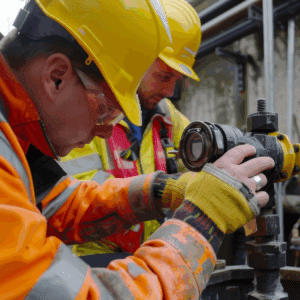 The modern utility and public sector workforce is increasingly hybrid, as internal crews handle core operations, contractors deliver specialized expertise and surge capacity, and mutual aid provides external resources during emergencies. Each of these groups needs appropriate system access while maintaining security and accountability.
Most platforms, however, treat contractors as peripheral users, limiting access or forcing them into separate systems. This disconnect creates coordination nightmares precisely when their integration matters most. When you double your workforce during a major storm response, for example, operational visibility shouldn’t degrade.
Internally, organizational silos persist across multiple departments: water and sewer, electric, streets, and parks, each maintaining separate systems. When a water main breaks near electrical infrastructure, these disconnects can slow response teams, limit their visibility into ongoing work, or create safety hazards.
The Unified Platform Imperative
KloudGin was designed from day one as a truly unified platform, not separate modules that claim to integrate. One platform handling meter operations, public works, emergency response, and multi-year projects, linear assets and vertical infrastructure, internal crews and external contractors – all operating from the same shared operational intelligence, and all updating the same asset and work records.
The business outcomes of this approach are significant. Organizations that have transitioned to unified operations report 15-25% gains in field productivity within the first year. Asset and work data quality improves dramatically because every field interaction updates the same records, whether it’s an emergency repair or planned maintenance. Supervisors and customer service teams finally have complete operational visibility, leading to faster resolution and higher customer satisfaction.
The Path Forward
As utilities and public sector organizations face unprecedented demands, meeting the challenges ahead requires operational platforms that reflect the full complexity of utility operations—by connecting all work types, asset classes, and work groups into a single, modern architecture.
Every day spent switching between systems, every coordination delay, every contractor working with incomplete information – these aren’t minor inefficiencies. They’re structural disadvantages that represent productivity losses which will continue to compound over time.
The Single Face of Work isn’t about reducing logins. It’s about true operational unity—a single system that connects all work, all assets, and all people in real time across every dimension of utility operations. When everyone operates from unified intelligence, organizations can focus on what matters most: delivering safe, reliable, essential services to the communities they serve.
This capability is here today. The results are proven. KloudGin is your partner for this moment.