
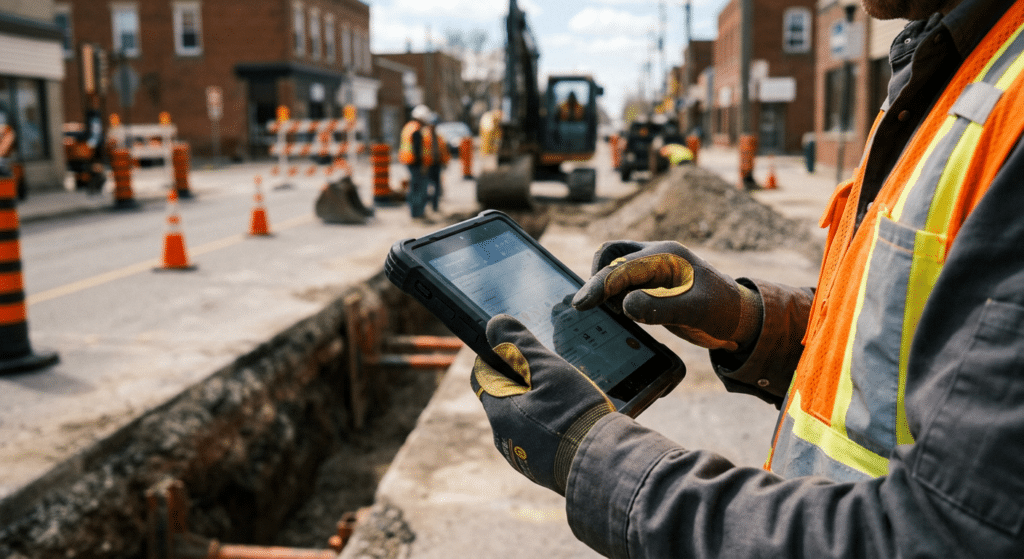

A street crew excavates a newly paved road, unaware that a subsurface repair was already scheduled. This isn’t a rare failure, it’s how fragmented operations show up in the real world.
The paving crew lacked visibility into the pending work order, while the subsurface team was unaware of the recent paving. Two separate systems and two disconnected departments led to an entirely avoidable, public failure.
This scenario is not unique; it is a predictable, and preventable, result of fragmented operations. And it’s happening every day, across utilities and municipalities that rely on disconnected systems to run coordinated work.
The average utility or municipality currently uses 15-20 separate software applications to manage operations. While each system addresses a specific function, such as asset management, field service, or GIS, they largely operate in isolation. Additionally, most were developed before cloud computing, mobile native tools, or AI-assisted planning.
The impact extends beyond outdated technology, as fragmented systems create compounding inefficiencies that quietly erode organizational effectiveness and increase costs over time. What looks like “just IT complexity” is actually lost productivity, failed coordination, and preventable cost at scale.
The Compounding Cost of Fragmentation
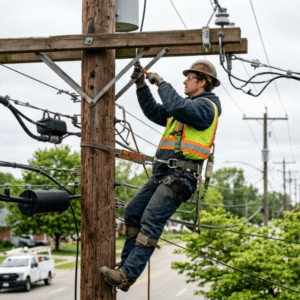 The most apparent consequence of fragmentation is reduced productivity. Research shows that switching between systems, manually reconciling information, and re-entering data consumes 20%-30% of workforce capacity daily. In practical terms, this means that crews spend hours navigating systems instead of completing work. Utilities recover only 70 to 78 cents of value for every dollar spent on labor, as the remainder is lost to inefficiencies that modern technology could address.
Equally significant, though less visible, are the challenges at the mobile layer. Most enterprise platforms were originally designed for desktop workflows and subsequently retrofitted with mobile capabilities. For field crews, this isn’t a design flaw, it’s a daily constraint. When back-office and field applications operate on separate databases, organizations must determine which data to synchronize, inevitably resulting in compromises.
This disconnect means that field crews often arrive on site with incomplete asset histories. Dynamic forms, GPS data capture, barcode scanning, and digital signatures frequently fail to transfer to mobile devices. When these features are unavailable, crews revert to paper-based processes, resulting in data that must be manually re-entered, added to change orders, or lost entirely.
The downstream effects are significant. When data remains on paper, the asset management system cannot serve as an operational historian. Maintenance patterns become unclear, repeat failures go unnoticed, and predictive intelligence never materializes, not because the technology failed, but because the data foundation was never fully established.
The operational impact of this affects the entire organization. Dispatchers schedule work using outdated information. Customer service teams are unable to provide accurate restoration times without real-time field data. Follow-up work orders are lost between systems, and compliance reporting becomes a manual, isolated process.
What started as disconnected systems becomes organization-wide blind spots. Incidents like street crews excavating newly paved roads are not just IT issues. They are highly visible, costly, and entirely preventable failures of coordination, and public stewardship.
Four Forces Removing the Margin for Error
Continuing to tolerate these inefficiencies is no longer viable. Four converging forces are now making fragmented operations unsustainable:
- Infrastructure demand is rising, and disconnected systems cannot keep up. Electricity needs for AI data centers alone may increase from 25 gigawatts (GW) to over 100 GW by 2035. This exponential growth requires coordinated execution across planning, assets, and field work.
- Workforce knowledge preservation is a real risk. Around one-third of utility and municipal employees will be eligible for retirement this year. Fragmented systems have failed to capture and operationalize institutional knowledge. When knowledge lives in people instead of systems, it walks out the door.
- Customer expectations have changed. Real-time service visibility is now standard, influenced by companies like Amazon and Uber. Utilities that cannot provide accurate, real-time updates face increased scrutiny from regulators, customers, and the media.
- Grid transformation is advancing regardless of organizational readiness. Over 1,350 GW of distributed energy resources await interconnection. Managing this complexity requires unified, real-time coordination across assets, teams, and work typesThis level of complexity cannot be managed in silos.
What a Single Face of Work® Actually Means
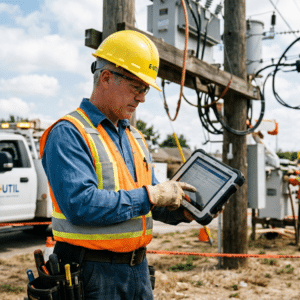 As one of our customers put it, “This is a single face of work for us, any work, regardless of type.” While the concept is simple, its operational implications run deep.
A single face of work means every organizational role, from field technicians and dispatchers to planners, customer service representatives, and compliance officers, operates from the same system. Instead of relying on systems that synchronize periodically, all users access a live, shared source of truth. No manual reconciliation. No lag. No second-guessing the data.
In utility operations, assets and teams are interdependent, and emergency and routine work often overlap. Managing these activities in separate systems leads to frequent coordination failures, not because of people, but because of system design.
A true single face of work requires three things:
- All work types, spanning emergency dispatch through to long-term capital projects, are visible within a single system.
- All asset classes, including linear and vertical infrastructure, are managed on a single platform.
- All work groups, including internal crews, contractors, and mutual aid, are coordinated, with access that scales as the workforce grows.
The Architectural Requirement
Unified operations require more than improved integration. They need a fundamentally different data architecture, one where construction work management, field service, and asset management share a single database.
This distinction is more important than it may seem. When a technician updates a work order in a shared database, all stakeholders receive the information instantly. There are no synchronization cycles, no decisions about data transfer, and no delay between field activity and back-office records. Updates are immediate and accessible to everyone.
Operational platforms that synchronize separate databases require ongoing, costly decisions about which data to transfer and when. Those decisions introduce friction, and friction compounds.
These choices often force crews to use paper for unsupported workflows, reduce mobile performance, and lead to decisions based on incomplete information. For organizations using disconnected systems, digital transformation remains perpetually out of reach, regardless of technology investments.
Shared data shapes daily decision-making in ways that add up over time. The impact isn’t just system-level, but impacts workforce culture. For example, a technician noticing repeated asset failures can alert engineering instead of just logging another repair. Crews aware of nearby maintenance work can consolidate site visits. These small, real-time decisions across the workforce drive large, cumulative gains.
The Outcomes That Follow
The benefits of unified operations are well documented. KloudGin has observed the following results across numerous utility and municipal deployments:
- First-time fix rates increase by 30% or more
- Field productivity gains of 20% or more in the first year
- System maintenance costs drop by 35-40%
- New hires reach full proficiency 40% faster
These aren’t incremental improvements, but represent structural gains driven by eliminating fragmentation.
Unified data also supports the adoption of advanced technologies, as clean, consistent data is essential for AI, analytics, and digital twin tools. Organizations with integrated data gain substantial value as these technologies mature, while others remain constrained, not because of technology, but because they lack the data foundation to use it.
The Reframe That Matters
 Organizations making this transition observe a consistent pattern: the most significant change is organizational, not technical. The central question shifts from ‘Which system should we purchase?’ to ‘‘Why is work breaking down today, and how should it actually get done?’
Utilities and municipalities that start with this question achieve more than just a platform replacement. They identify opportunities to eliminate system sprawl, adopt proven best practices, and redesign workflows instead of digitizing inefficiencies.
The most successful organizations, recover productivity and improve data quality for AI and predictive intelligence, achieve these results not just through software acquisition, but through operational alignment.
They start with a different premise: that every person involved in work should have a complete, accurate, and real-time view of their work, at all times.
This approach exemplifies the Single Face of Work® standard. It is not just an operational model, but a benchmark that separates organizations that have overcome fragmentation from those still absorbing its daily costs.
About KloudGin
KloudGin is a cloud-native solution provider delivering the utility and public service’s only true “Single Face of Work®” platform that unifies Construction Work Management, Enterprise Asset Management, and Field Service Management within one operational ecosystem. Recognized as a Leader in both the IDC MarketScape for Utilities EAM and FSM, KloudGin’s AI-native platform is purpose-built as the operational engine for utility and public sector workers, eliminating silos between systems and processes and connecting all work operations in real time to empower the workforce that keeps essential services running across communities worldwide.
