
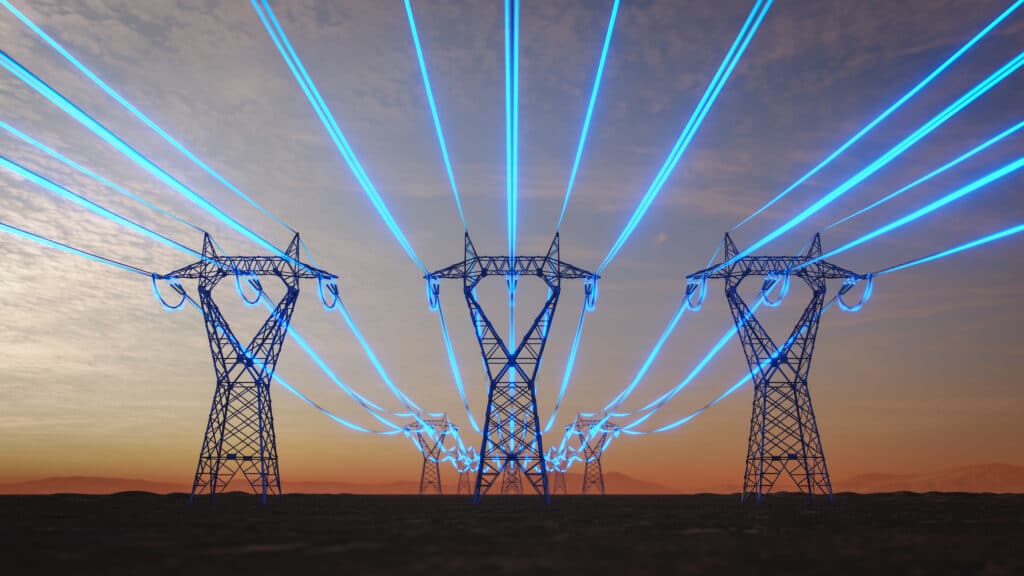

For decades, the utility industry has awaited a catalyst for true grid modernization. Distributed renewables and utility-scale battery storage each appeared likely to drive this change, but neither delivered the expected transformation.
It was clear at Distributech this year that data centers have changed the equation entirely. Unlike previous waves, this one is not hypothetical. AI workloads and national security imperatives are driving demand growth not seen since rural electrification — projected to go from 25 GW in 2024 to over 100 GW by 2035. When you combine that with electrification and manufacturing reshoring, the scale becomes unmistakable. We are witnessing the largest infrastructure buildout in a century.
This surge requires utilities to move beyond incremental updates to Edison’s original grid architecture. New transmission lines and substations must be designed, built, and commissioned. Aging assets require inspection, maintenance, and replacement, all while maintaining reliable service. Field crews need to operate safely in increasingly complex environments. And DERMS, grid-edge technologies, and customer-owned distributed resources must be integrated into networks not designed for bidirectional power flow.
Each of these priorities demands the highest operational standards across asset management, construction execution, and field work coordination. Taken together, they represent not incremental change, but systemic transformation. The era of doing ‘just enough’ has ended.
Doing More With the Same
It is important to recognize what every utility and public sector leader already knows: you are being asked to modernize the grid, integrate distributed resources, meet rising demand, and satisfy higher customer expectations — all with essentially the same resources, workforce, and budgets.
 This is a significant challenge. Infrastructure teams are already working hard, and budgets are stretched, yet the demands continue to grow. We hear this from utility leaders every day.
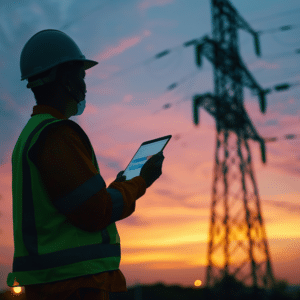
This is why operational efficiency is essential. When field teams work better, faster, and safer, — and technology supports them — you recover time and resources for high-value tasks. Every minute saved through modern tools and coordination contributes to the work that matters most.
These incremental gains, when scaled across the distributed workforce — employees and contractors alike — become transformative. What feels small at the individual level becomes strategic at scale.
The Question That Matters: How Do We Do Better?
If the challenge is to do more with the same resources, the key question is: how do we help every worker perform at their best?
The answer begins with equipping teams with the most advanced tools that are intuitive to use, easy to deploy, and simple to maintain — while applying AI in ways that genuinely improve their daily work.
At KloudGin, we believe technology should empower workers to perform better, faster, and safer. This belief guides our approach to AI. We focus on embedding AI into daily workflows to capture institutional knowledge, provide timely information, and reduce administrative burdens that distract skilled professionals from their core work.
The result is clear: our Asset IQ solutions return, on average, 30 minutes to each worker every day. While this may seem modest, at scale it means thousands of hours reclaimed weekly across the workforce. These hours can be redirected to modernization, preventive maintenance, emergency preparedness, and customer service.
This is the right use of AI: delivering immediate, exponential value through incremental improvements that benefit every crew, every shift, and every day.
The Nexus of Field Work, Construction, and Asset Management
Grid modernization highlights what traditional software architectures have long obscured: field service management, construction work management, and enterprise asset management are not separate disciplines, but deeply interconnected aspects of the same operational reality.
 Construction crews generate asset records that maintenance teams rely on, often for decades. Field service work informs capital planning. Asset condition data guides emergency response and construction sequencing. All of these work streams share assets, personnel, and data, yet most utilities manage them on separate platforms.
This complexity is only increasing. Linear networks now include hybrid assets, such as utility-owned infrastructure combined with customer-owned solar, battery storage, and EV chargers. The workforce is also hybrid, with employees, contractors, and mutual aid crews all requiring coordinated access to the same information.
Managing this reality across disconnected systems is more than inefficient — it’s a significant barrier to modernization.
Why the Single Face of Work® Matters More Than Ever
These converging challenges are exactly what KloudGin was built to address. Our platform enables field crews, construction teams, asset managers, planners, dispatchers, and customer service representatives to operate from a unified system that reflects how work actually happens in the field.
Our Single Face of Work approach unifies field service, enterprise asset management, and construction work management on a platform-built for utility operations. It manages linear and vertical assets, supports all workforce types with appropriate access, and, with AIQ embedded, provides every worker with AI-powered intelligence that helps them perform at their best. With our single, intelligent platform, we enable teams to work with greater clarity, confidence, and coordination — every day, in every environment.
In this era of grid modernization, the organizations that equip their teams with the best tools and maximize the value of every work hour will gain a clear and lasting competitive advantage. This has always been our mission at KloudGin: helping utilities translate operational complexity into operational strength. As the industry enters its most transformative period in a century, we remain committed to helping you build the foundation your future requires.
Modernization is happening now — and we are here to work side by side with you to help innovate, adapt, and succeed in what comes next.